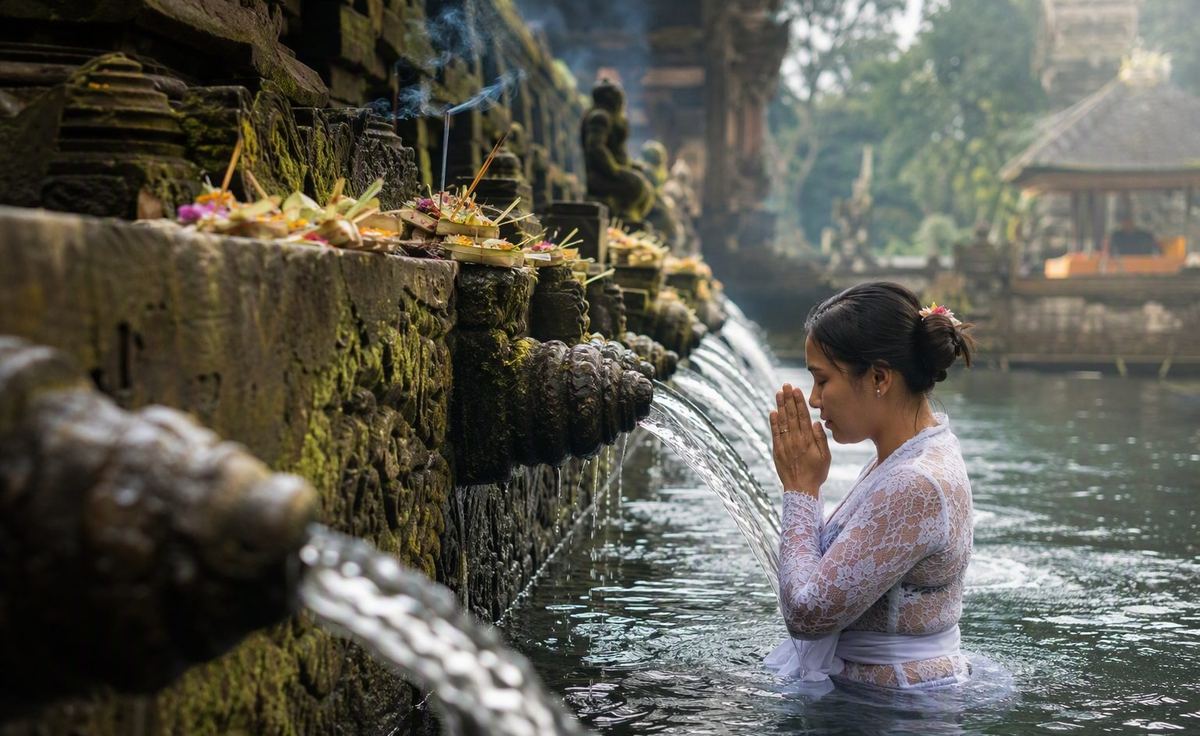
Stand at the edge of the purification pools at Tirta Empul and you will see something rare: a queue of people — Balinese families, village elders, travellers from every continent — waiting in sarongs beneath thirteen stone fountains, each person quietly preparing to be washed clean. This is melukat, and it has been happening here, without interruption, for over a thousand years.
What melukat means
The word melukat comes from the Balinese root lukat — to purify, to cleanse, to let go. In Balinese Hindu understanding, the body and soul gather residue the way a house gathers dust: stress, grief, old anger, illness, the weight of other people's energy. Melukat is the energetic reset — a ritual washing that restores the natural balance between the physical and spiritual, the seen and unseen, the inner and outer world.
The holy spring
Tirta Empul — literally 'holy water spring' — was founded around 962 AD in the Warmadewa dynasty. Legend holds that the god Indra created the spring to revive his poisoned troops after battle with the dark king Mayadanawa. The spring still rises today, feeding the pools where the ceremony is performed. The temple is dedicated to Vishnu, the preserver, and remains one of the most important pilgrimage sites in Bali.
How the ceremony unfolds
A melukat ceremony moves in stages. First, preparation: a sarong and sash, and a canang sari offering made or received. Then prayer at the shrine — a moment to set the intention, to name what you are releasing. Then the fountains: traditionally you begin at the leftmost spouts and move one by one, letting the water pour over your head, rinsing the face, letting each fountain carry a different layer — body, mind, heart, soul, karma. Two fountains are reserved for priests and the rites of the deceased; everyone steps past them. Finally, a blessing: holy water sprinkled, rice grains pressed to the forehead — prosperity and purity, sealed.
The etiquette that matters
Melukat is a living sacrament, not a photo opportunity. Wear the sarong and sash with respect. Bring a bathing sarong and a change of clothes. Move around offerings on the ground, never over them. Keep the voice low, the phone away during the ritual itself, and enter with humility. You do not need to be Hindu to participate — sincerity is the only credential the water asks for.
Why it still works
From a modern perspective, melukat is a masterpiece of embodied psychology: cold water slowing the breath, ritual giving shape to release, intention made physical, community witnessing. People emerge lighter not because something magical happened to them, but because they finally allowed something to leave. The Balinese would simply say: the water knew what to do.
On the Aurelia pilgrimage, melukat is not a stop on an itinerary. It is the second movement of the journey — prepared for in circle, guided by a temple priest, and integrated in silence beside the spring pond afterwards, journal in hand. Some releases deserve that much care.